Skip to content
Managed Flows

Features

What Managed Flows does

Everything on this page is set up by your administrator in the configuration screens. No programming is involved.

Configure

Forms with tabs and fields

For each kind of work you decide what a case looks like: which data it holds, on which tab and in which order. A form can have parts, such as a payment plan for a grant.

  • Twelve field types: text, text area, email, date, choice list, multiple choice list, checkbox, whole number, large whole number, decimal number, amount and file.
  • Fields that only appear when an earlier answer calls for them.
  • Format checks, such as postcode, phone and bank account number.
  • A calculated starting value for dates, for example a deadline a number of weeks after receipt.
  • Sensitive fields hidden from anyone without the right to see them.
  • A choice list filled with the users of your environment, to name a case officer or account manager.
  • A status field with phases you name yourself, shown as a bar above the case.
  • Your own case numbering per kind of work.
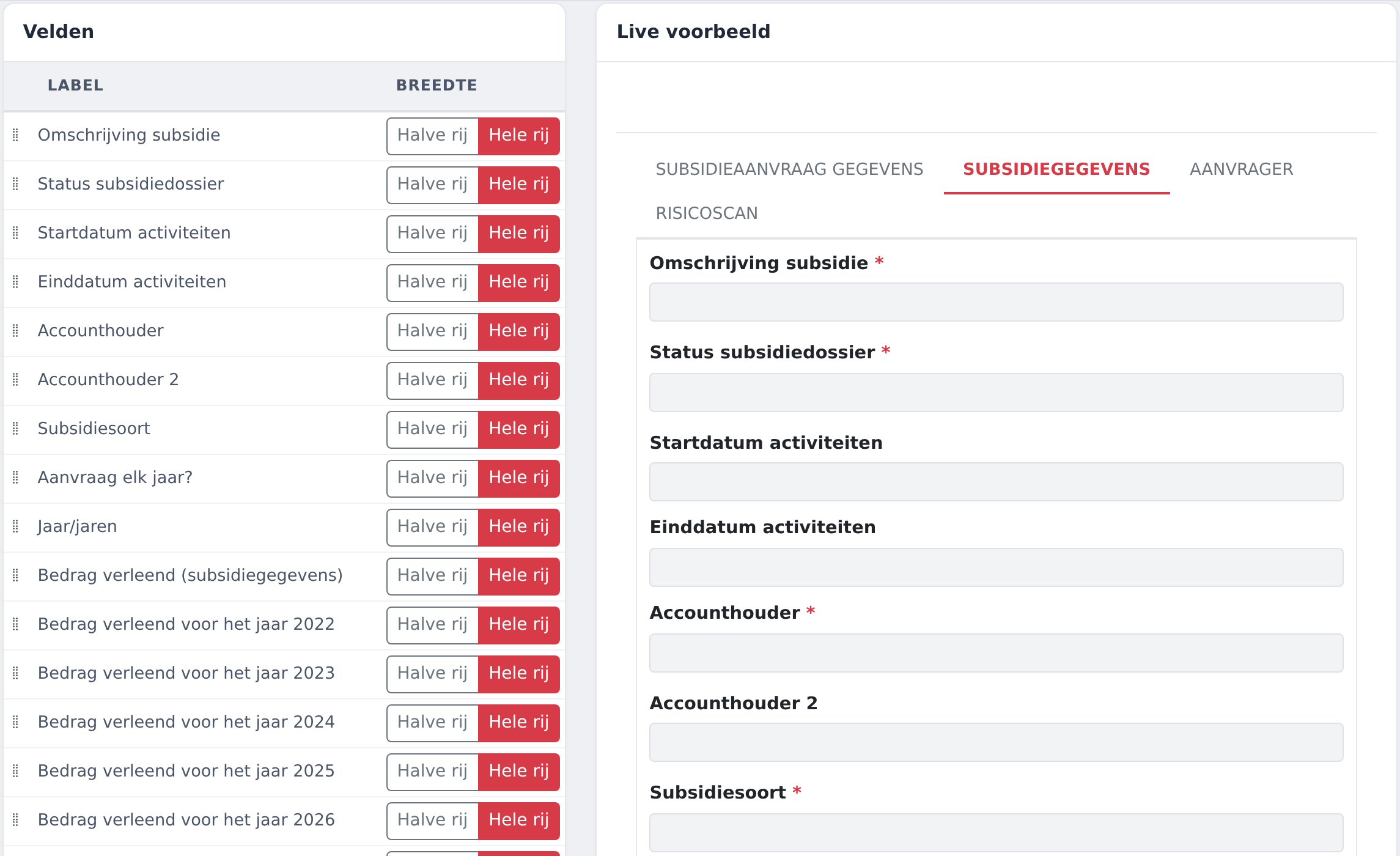
The layout of the Standard grant form: the width of each field, next to a live preview.

Workflow

Steps, owners and outcomes

A workflow is the route a case takes. For each step you define whose turn it is, what needs checking and which outcomes are possible.

  • Assignment to a person, to a team, or to the person named in a field of the case.
  • A checklist per step, with required and optional items.
  • Required fields and documents before a step can be completed.
  • Outcomes as buttons with your own names, each pointing to a next step. Including back to an earlier step.
  • Actions that run in parallel, and steps in which several people must all approve.
  • Several workflows on the same form, such as one for the application and one for the final settlement.
  • A version and a status per workflow, so you activate a new way of working on purpose.
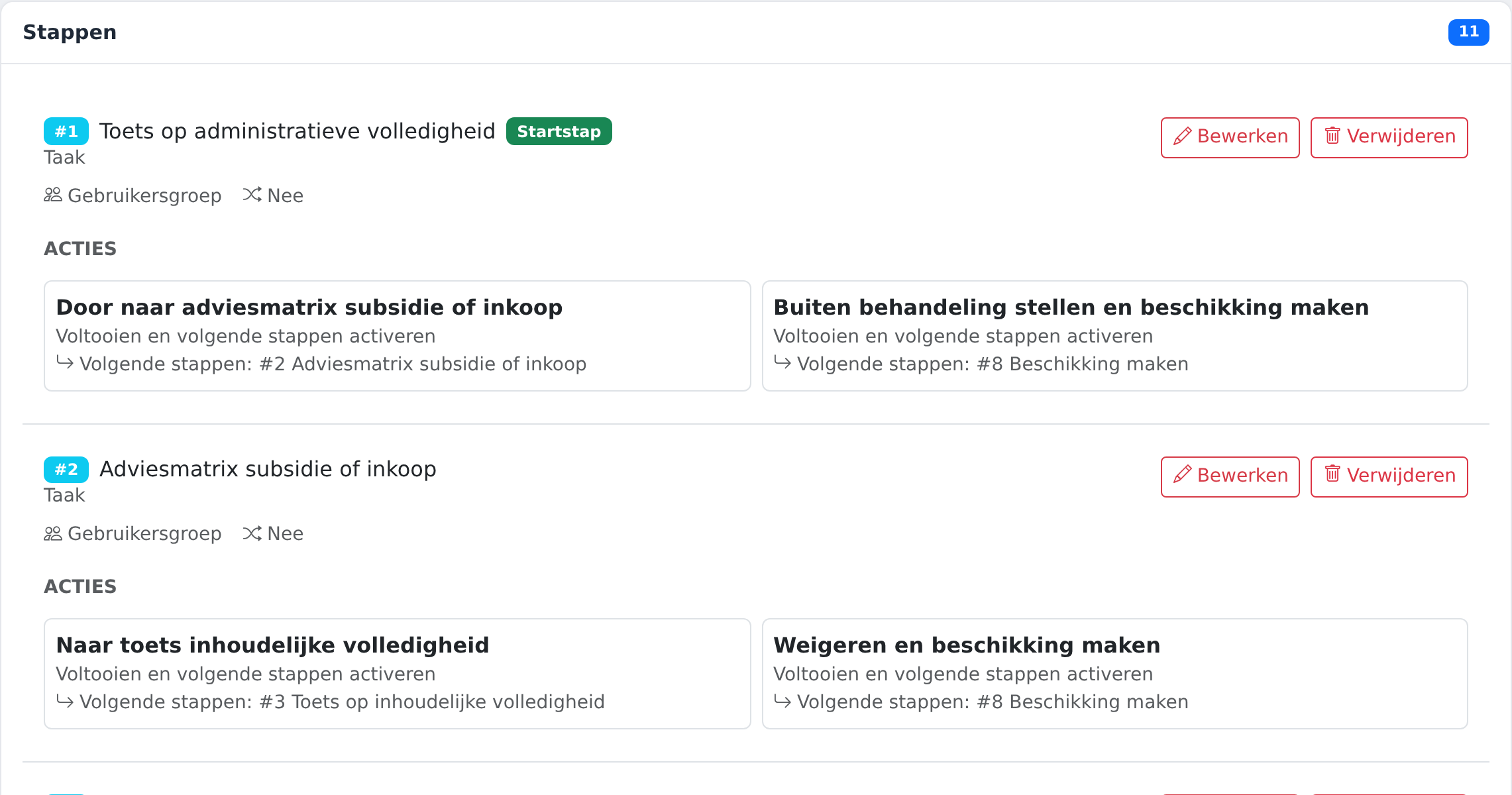
The workflow in the configuration screen: the outcomes of each step and the step that follows.

Notifications

The right people at the right time

A notification is a text with placeholders and a rule that decides when that text goes to whom. Nobody has to remember deadlines.

  • Rules when a case is created, when it changes, on a schedule, when a date approaches or is reached, and on a fixed date.
  • Conditions, so a rule only applies when a field has a certain value.
  • To a team, or to the person named in the case.
  • Email to internal and external addresses, with a record of delivery.
  • Notifications on screen and as a tile on the home screen. No duplicate while one is still open.
  • Tasks that are closed with an outcome.
  • Every user chooses which emails they receive.
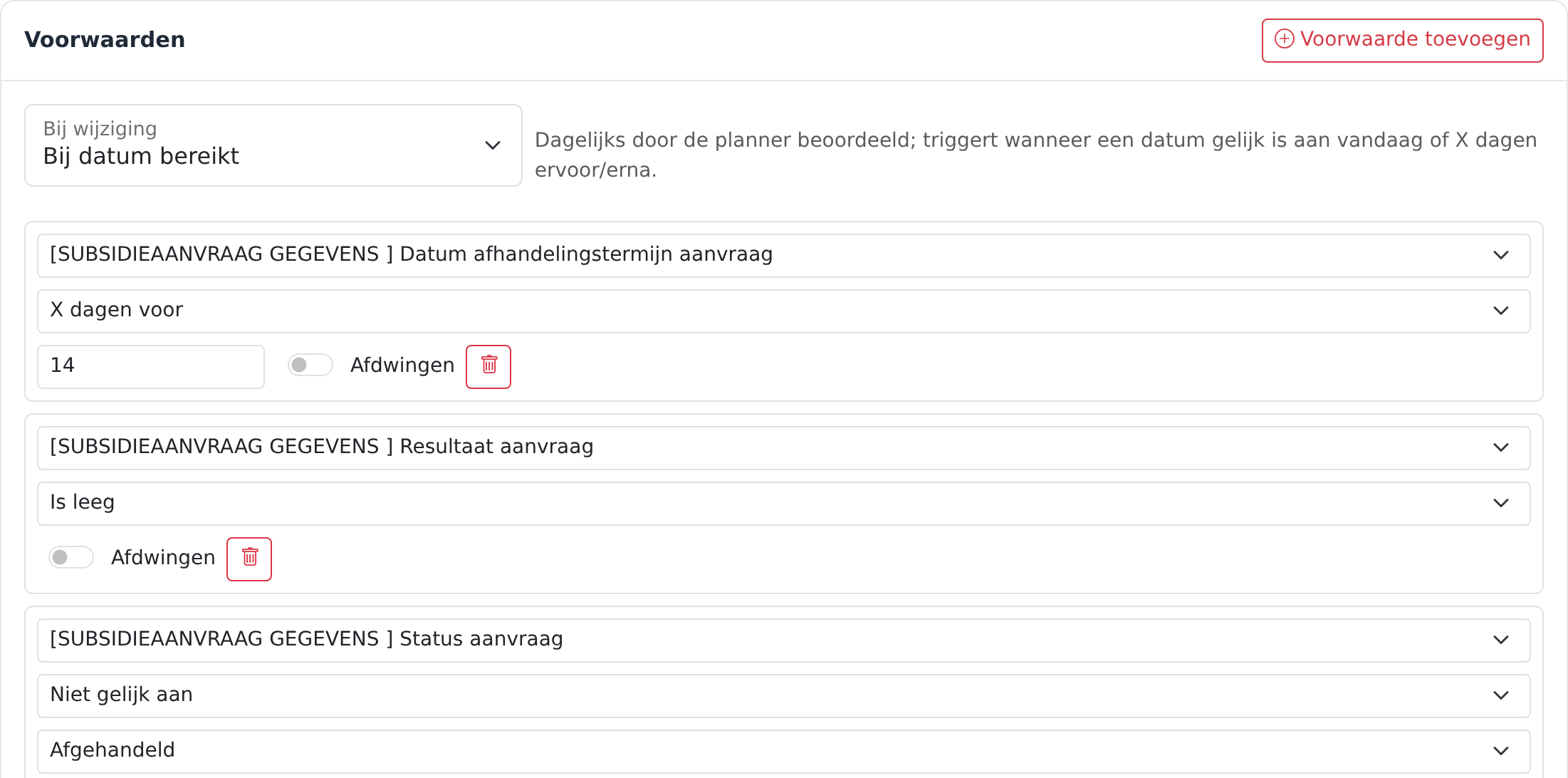
A notification rule: 14 days before an application's decision deadline, as long as it has not been decided.

Case

Documents, notes and history

Around every case grows the content that belongs to it. What changes is recorded.

  • Documents with the case, with properties such as type and status.
  • Notes from case officers and contact moments with the applicant or customer.
  • A history of every field change, with who and when.
  • Main cases with underlying cases.

Overview

Lists, dashboard and Excel

Everyone sees what matters to them, and management sees where the work stands.

  • Lists with the columns you choose, filtering on any field, sorting and paging.
  • A dashboard with tiles and key figures per user or per team.
  • Export to Excel, with filters you save for next time.
  • Import from Excel with a mapping profile, a preview and a check beforehand.
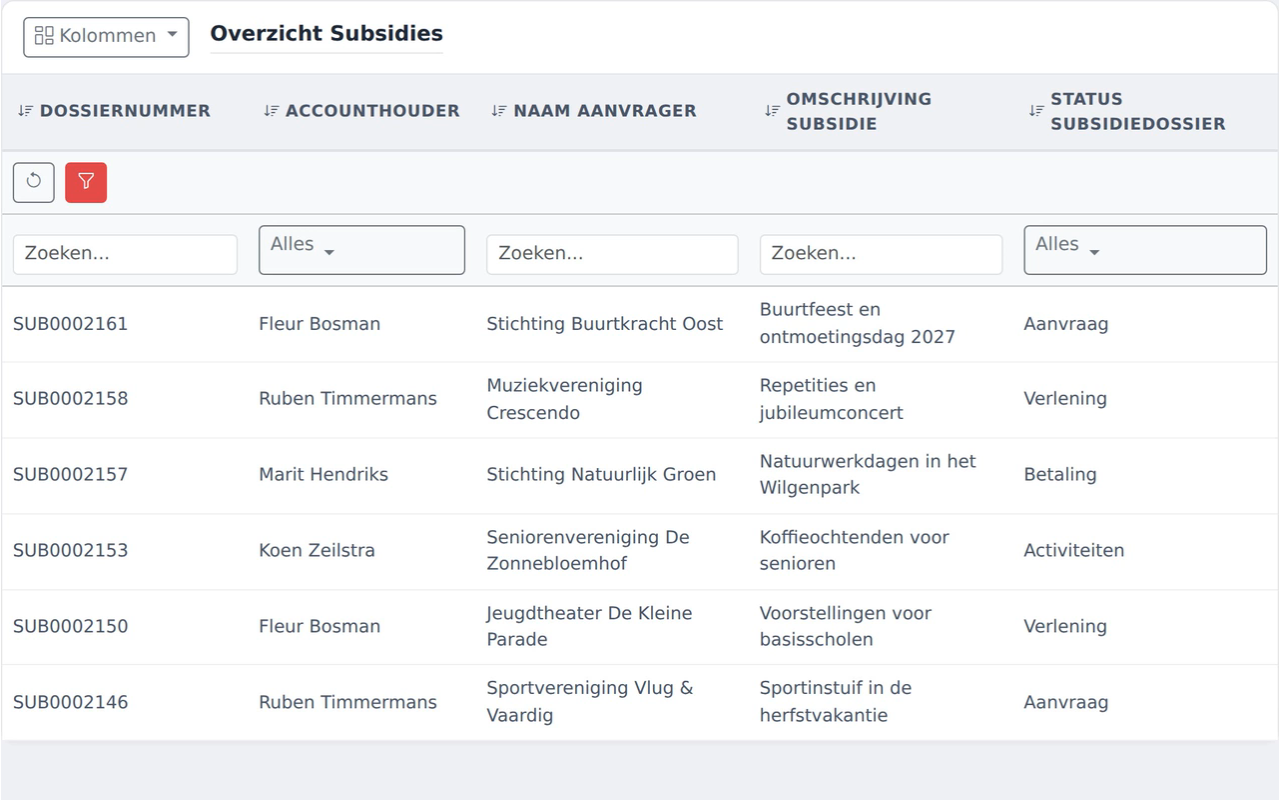
The Subsidies list with a search field per column.
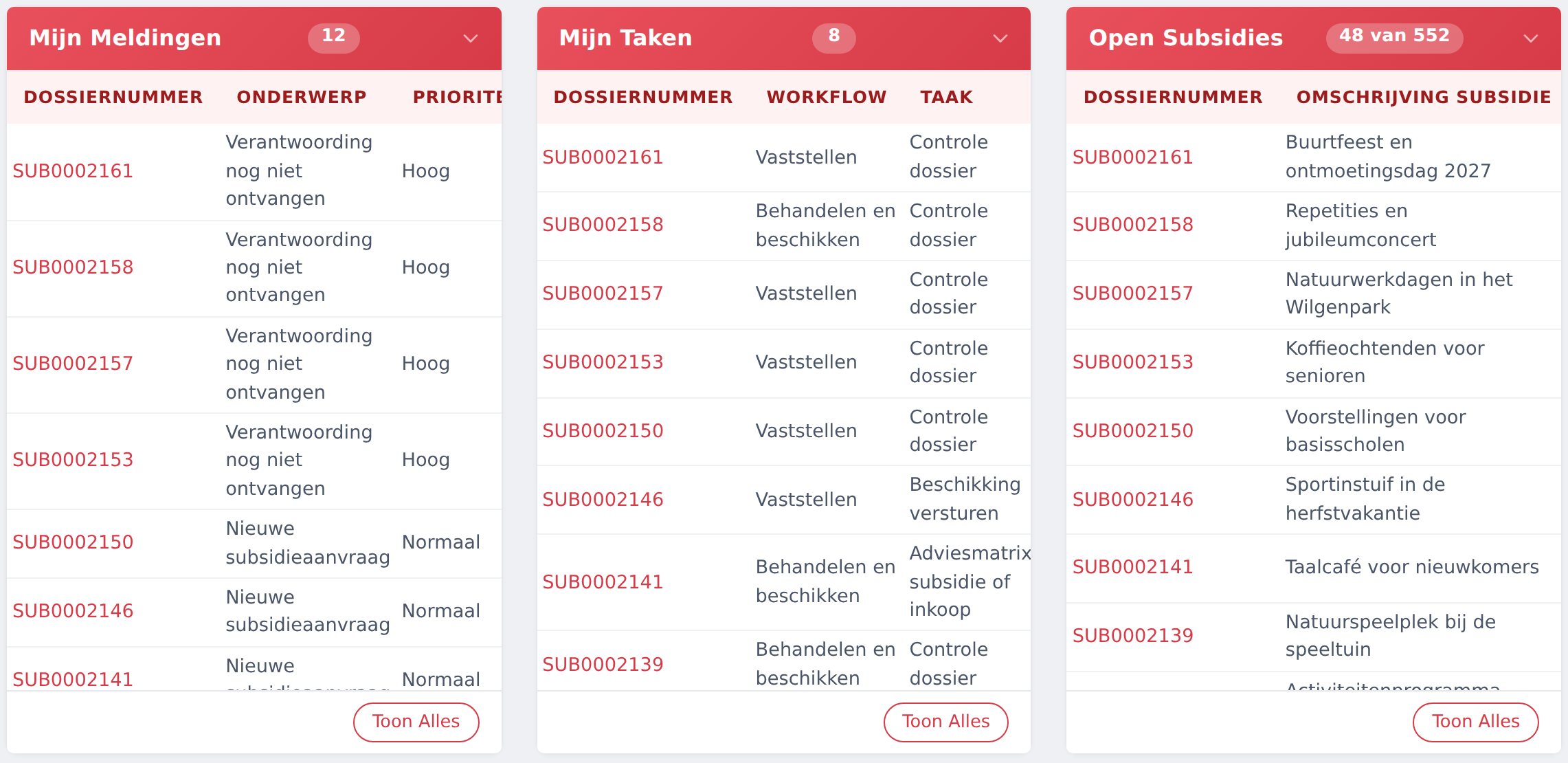
The dashboard with the tiles My notifications, My tasks and Open grants.

Integrations

Connect to what you already use

Managed Flows works with the systems around you, without changing the core of the product for one customer.

  • Online application forms: applications arrive automatically and become a case, with their attachments. For Dutch government this uses ZGW, the national standard for exchanging case data (Zaken, Documenten and Catalogi, version 1.3.1).
  • Forms on your own website, built by us and connected through the secure API.
  • A REST API with OAuth, through which other systems request or deliver data with permission.
  • Lookups with which a form fills in fields beforehand and checks values.

Access

Roles, permissions and security

You decide who may see and do what. Signing in is secured with a second step by default.

  • Roles with dozens of separate permissions.
  • Teams to which work is assigned.
  • Task delegation: during holidays or illness a colleague acts on your behalf, and every action records that.
  • Two-step verification with an authenticator app or a code by email.
  • A temporary lock after repeated failed sign-in attempts.
  • A record of viewing and editing per case and of sign-in attempts.

Delivery

Your own environment, our care

Managed Flows is delivered as a service. We keep the technology running, you configure the application.

  • A separate installation per customer, with its own database and its own address, in a data centre in the Netherlands.
  • New versions are prepared for you. You decide when they are installed.
  • An automatic backup before every update. If something goes wrong, the update is rolled back.
  • Screens in Dutch and English. Texts can be adjusted without a new version.

Rather see it than read about it?

In a demo we show how this comes together in a process you recognise.